High cholesterol is one of the leading risk factors for heart attack, stroke and cardiovascular disease, yet it is also one of the most misunderstood health conditions.
Many people receive a blood test showing elevated cholesterol levels and immediately wonder:
- Do I need medication?
- Is my cholesterol dangerous?
- Can I lower it naturally?
- Am I at risk of having a heart attack?
The answer is not always straightforward.
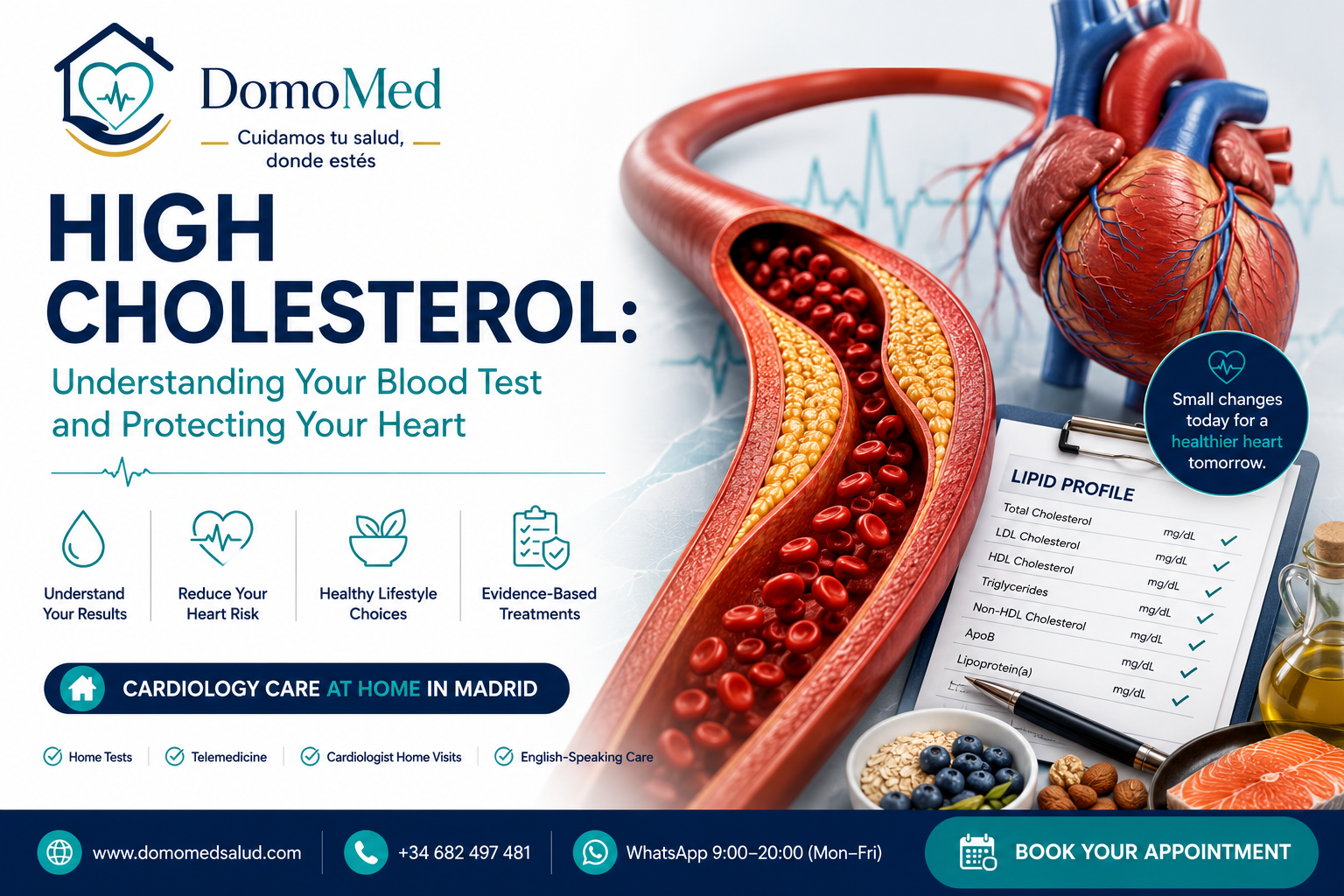
Today, cardiologists know that cardiovascular risk depends on much more than total cholesterol. Understanding LDL cholesterol (“bad cholesterol”), HDL cholesterol (“good cholesterol”), non-HDL cholesterol, triglycerides, and in selected patients Apolipoprotein B (ApoB) and Lipoprotein(a) [Lp(a)], provides a much more accurate assessment of cardiovascular risk.
High cholesterol rarely occurs in isolation. It frequently coexists with high blood pressure, diabetes, obesity, smoking and physical inactivity, significantly increasing the likelihood of developing cardiovascular disease.
If you also have high blood pressure, you may find our complete guide to High Blood Pressure helpful, where we explain how these risk factors work together and why treating them comprehensively is essential.
In this evidence-based guide, we explain what high cholesterol really means, how to interpret your blood test, what cholesterol levels are considered healthy, and which lifestyle changes and treatments have been proven to reduce the risk of heart attack and stroke.
What is cholesterol?
Cholesterol is a fatty substance that is essential for normal body function.
Your body uses cholesterol to:
- Build healthy cell membranes.
- Produce hormones.
- Synthesize vitamin D.
- Produce bile acids needed for digestion.
Although cholesterol is obtained from food, most of it is produced naturally by the liver.
Problems arise when excessive amounts of cholesterol-carrying particles—particularly Low-Density Lipoprotein (LDL)—accumulate within the walls of arteries.
Over time, this process leads to atherosclerosis, the gradual build-up of fatty plaques inside blood vessels.
If left untreated, these plaques may eventually cause:
- Heart attack.
- Stroke.
- Peripheral artery disease.
- Coronary artery disease.
- Heart failure.
Importantly, this process develops slowly over many years, often without causing any warning signs.
What are the symptoms of high cholesterol?
One of the most important facts about high cholesterol is that it usually causes no symptoms at all.
Most people feel completely healthy while cholesterol slowly builds up inside their arteries.
For this reason, high cholesterol often remains undiagnosed until it is discovered during a routine blood test—or, unfortunately, after a cardiovascular event such as a heart attack or stroke.
In rare cases, people with Familial Hypercholesterolaemia (FH) may develop visible signs including:
- Tendon xanthomas.
- Xanthelasma around the eyelids.
- Early corneal arcus in younger individuals.
These findings are uncommon.
Contrary to popular belief, high cholesterol does not usually cause headaches, dizziness or fatigue.
If these symptoms occur, another medical condition is usually responsible and should be evaluated by a healthcare professional.
What are normal cholesterol levels?
One of the most common questions after receiving a blood test is:
“Are my cholesterol levels normal?”
The answer depends on your overall cardiovascular risk.
As a general guide:
| Lipid Parameter | General Reference Value |
|---|---|
| Total Cholesterol | Less than 200 mg/dL |
| LDL Cholesterol | Depends on cardiovascular risk |
| HDL Cholesterol | Above 40 mg/dL (men) / Above 50 mg/dL (women) |
| Triglycerides | Less than 150 mg/dL |
| Non-HDL Cholesterol | Depends on cardiovascular risk |
Current international guidelines focus primarily on LDL cholesterol, because lowering LDL has consistently been shown to reduce the risk of heart attack, stroke and cardiovascular death.
Patients with established cardiovascular disease or very high cardiovascular risk require substantially lower LDL targets than healthy individuals.
Understanding your cholesterol blood test
Many people believe cholesterol is represented by a single number.
In reality, a lipid profile contains several important measurements.
LDL cholesterol (“Bad cholesterol”)
LDL transports cholesterol from the liver to body tissues.
When LDL levels become elevated, cholesterol particles enter the arterial wall and contribute to plaque formation.
For this reason, lowering LDL remains the main goal of cholesterol treatment.
The lower the LDL level in high-risk patients, the lower the likelihood of future cardiovascular events.
HDL cholesterol (“Good cholesterol”)
HDL helps transport excess cholesterol back to the liver for removal.
Although HDL has traditionally been called “good cholesterol”, modern research has shown that simply increasing HDL levels does not necessarily reduce cardiovascular events.
Today, the primary objective is lowering atherogenic cholesterol, particularly LDL.
Non-HDL cholesterol
Non-HDL cholesterol includes all cholesterol-containing particles capable of promoting atherosclerosis.
It is calculated simply by subtracting HDL cholesterol from total cholesterol.
It is particularly useful in patients with:
- Diabetes.
- Obesity.
- High triglycerides.
- Metabolic syndrome.
Many experts consider non-HDL cholesterol to provide a more comprehensive estimate of cardiovascular risk than LDL alone.
Triglycerides
Triglycerides are the body’s main form of stored energy.
Although they behave differently from LDL cholesterol, elevated triglyceride levels are associated with increased cardiovascular risk and, when extremely high, may increase the risk of acute pancreatitis.
Common causes include:
- Obesity.
- Type 2 diabetes.
- Excess alcohol intake.
- Diets rich in refined carbohydrates.
- Physical inactivity.
Which cholesterol is the most dangerous?
This is one of the most common questions patients ask.
The answer is clear.
LDL cholesterol remains the most important cholesterol particle to reduce because lowering LDL consistently decreases the risk of heart attack and stroke.
However, LDL is no longer the only marker doctors consider.
Additional tests may provide valuable information in selected patients, including:
- Non-HDL cholesterol
- Apolipoprotein B (ApoB)
- Lipoprotein(a) [Lp(a)]
Lp(a), in particular, is largely determined by genetics and may significantly increase cardiovascular risk even when LDL cholesterol appears well controlled.
For this reason, cholesterol results should always be interpreted within the context of each patient’s overall cardiovascular risk.
A single cholesterol value never tells the whole story.
Why does high cholesterol increase the risk of heart attack?
When LDL cholesterol remains elevated for many years, cholesterol particles gradually accumulate within the arterial wall.
Over time, these fatty deposits form atherosclerotic plaques.
If one of these plaques ruptures, a blood clot may suddenly block the artery.
Depending on where this occurs, it may cause:
- Heart attack
- Stroke
- Peripheral artery disease
If you would like to learn more about recognising the symptoms of a heart attack or angina, read our guide to Chest Pain and Coronary Artery Disease.
Take the next step towards better heart health
A cholesterol blood test is only one part of assessing cardiovascular risk.
Some patients benefit from a comprehensive cardiovascular assessment, including diagnostic investigations that help identify hidden heart disease before symptoms develop.
At DomoMed Salud, we provide home cardiology diagnostic tests in Madrid, including ECG, Holter monitoring and cardiovascular assessment performed by experienced cardiologists.
Explore our Home Cardiology Tests https://domomedsalud.com/en/cardiology-tests-madrid/
Who is at greatest risk from high cholesterol?
Not everyone with elevated cholesterol has the same risk of developing cardiovascular disease.
Today, cardiologists assess overall cardiovascular risk, rather than relying on a single cholesterol value.
Two people may have exactly the same LDL cholesterol level but require completely different treatment depending on other risk factors.
The most important cardiovascular risk factors include:
- High blood pressure
- Type 2 diabetes
- Smoking
- Obesity or excess body weight
- Physical inactivity
- Chronic kidney disease
- Family history of premature cardiovascular disease
- Increasing age
- Previous heart attack, stroke or peripheral artery disease
When several of these conditions are present together, the overall cardiovascular risk increases substantially.
When should you have your cholesterol checked?
Most adults should have their cholesterol measured at least once during adulthood.
The frequency of testing depends on age, cardiovascular risk and previous results.
More frequent monitoring is recommended for people with:
- Diabetes
- High blood pressure
- Previous cardiovascular disease
- Chronic kidney disease
- Known high cholesterol
- Familial hypercholesterolaemia
- A family history of early heart disease
Children and adolescents may also benefit from cholesterol testing when there is a strong family history of inherited high cholesterol.
How should you interpret your cholesterol blood test?
Many people focus only on the numbers highlighted in red on their laboratory report.
However, cholesterol results should always be interpreted within the context of the individual’s overall health.
Your doctor will consider factors such as:
- Age
- Sex
- Blood pressure
- Diabetes
- Smoking status
- Kidney function
- Family history
- Previous cardiovascular disease
- Overall cardiovascular risk
For example, an LDL cholesterol level of 130 mg/dL may be acceptable for one person but require treatment in another with diabetes or established cardiovascular disease.
The goal is no longer simply to achieve “normal cholesterol”, but to reach the cholesterol target that best matches each person’s cardiovascular risk.
Non-HDL cholesterol: an increasingly important marker
Although LDL cholesterol remains the primary treatment target, non-HDL cholesterol has become increasingly important in modern cardiovascular prevention.
Non-HDL cholesterol includes all cholesterol-containing particles capable of causing atherosclerosis, not just LDL.
It is particularly useful in patients with:
- Type 2 diabetes
- Obesity
- High triglycerides
- Metabolic syndrome
Many specialists consider non-HDL cholesterol to provide a more complete picture of cardiovascular risk than LDL cholesterol alone.
What is ApoB and why can it be useful?
Apolipoprotein B (ApoB) reflects the total number of atherogenic lipoprotein particles circulating in the bloodstream.
Two individuals may have identical LDL cholesterol levels but very different numbers of LDL particles.
Higher ApoB concentrations are associated with an increased risk of cardiovascular disease.
ApoB measurement may be particularly helpful in patients with:
- Diabetes
- Obesity
- High triglycerides
- Metabolic syndrome
- Premature cardiovascular disease
Although it is not required for everyone, ApoB can help personalise cardiovascular risk assessment in selected patients.
Lipoprotein(a): the inherited cholesterol risk factor
Lipoprotein(a), or Lp(a), is one of the most important inherited cardiovascular risk factors.
Unlike LDL cholesterol, Lp(a) levels are determined almost entirely by genetics and remain relatively stable throughout life.
Current international guidelines recommend measuring Lp(a) at least once during adulthood.
Testing may be especially useful if you have:
- A family history of early heart attack or stroke
- Familial hypercholesterolaemia
- Unexpected cardiovascular disease despite apparently normal cholesterol levels
A high Lp(a) level often leads doctors to recommend more aggressive LDL cholesterol lowering.
Which foods increase cholesterol?
Diet plays an important role in cholesterol management, although it is only one part of the overall picture.
Foods that should generally be limited include:
- Processed meats
- Sausages
- Butter
- Cream
- High-fat cheese
- Industrial pastries
- Ultra-processed foods
- Foods containing trans fats
- Products made with palm oil
Current dietary recommendations focus less on avoiding individual foods and more on adopting an overall heart-healthy eating pattern.
Which foods help lower cholesterol?
Scientific evidence consistently supports a Mediterranean-style eating pattern.
Foods associated with improved cholesterol levels include:
- Vegetables
- Fruit
- Legumes
- Oats
- Whole grains
- Extra virgin olive oil
- Nuts
- Oily fish
- Foods rich in soluble fibre
These foods not only improve cholesterol levels but also reduce the overall risk of cardiovascular disease.
If excess weight is also a concern, you may find our article on Obesity and Cardiovascular Risk helpful. It explains how weight loss can improve cholesterol, blood pressure and metabolic health.
If you are considering medical weight management, you can also read our comparison of Semaglutide vs Tirzepatide, where we review the latest clinical evidence on both treatments.
Can high cholesterol be reduced without medication?
For many people, the answer is yes.
Lifestyle changes alone can reduce LDL cholesterol by approximately 10–20%, depending on the individual’s starting point and the intensity of the intervention.
The most effective strategies include:
- Following a Mediterranean diet
- Exercising regularly
- Losing excess weight
- Stopping smoking
- Limiting alcohol intake
- Sleeping well
- Managing stress
However, lifestyle changes may not be sufficient for people with established cardiovascular disease or familial hypercholesterolaemia, where medication is usually required.
Exercise and cholesterol
Regular physical activity remains one of the most effective ways to improve overall cardiovascular health.
Current recommendations advise:
- At least 150 minutes of moderate-intensity aerobic exercise per week, or
- 75 minutes of vigorous activity weekly
Strength training should also be performed at least twice a week whenever possible.
Exercise improves:
- HDL cholesterol
- Triglycerides
- Blood pressure
- Blood sugar control
- Body weight
- Overall cardiovascular fitness
High cholesterol rarely comes alone
High cholesterol often occurs alongside other cardiovascular risk factors.
The combination of:
- High blood pressure
- Diabetes
- Obesity
- Smoking
can dramatically increase the likelihood of developing cardiovascular disease.
This is why modern preventive cardiology focuses on treating the whole patient rather than individual risk factors.
If you experience symptoms such as chest discomfort, breathlessness or reduced exercise tolerance, our guide to Chest Pain explains when these symptoms may require urgent medical assessment.
Take a personalised approach to cardiovascular prevention
A cholesterol result is only one part of understanding your heart health.
At DomoMed Salud, we provide personalised cardiovascular risk assessments, helping patients interpret cholesterol results within the context of their overall health.
Our services include home cardiology tests, telemedicine consultations and in-person cardiovascular assessments designed to support long-term heart health.
If you would like to discuss your cholesterol results or cardiovascular risk, you can contact the DomoMed team through our website to arrange a consultation.
When is medication needed to lower cholesterol?
Not everyone with high cholesterol requires medication.
Treatment decisions should always be based on overall cardiovascular risk, rather than a single cholesterol value.
Medication is generally recommended for people with:
- Established cardiovascular disease (heart attack, stroke or peripheral artery disease).
- LDL cholesterol ≥190 mg/dL.
- Familial Hypercholesterolaemia.
- Diabetes with increased cardiovascular risk.
- Chronic kidney disease.
- High or very high cardiovascular risk despite lifestyle measures.
For people at lower risk, improving diet, increasing physical activity and maintaining a healthy weight may be sufficient initially.
Statins: benefits, safety and common myths
Statins remain the first-line treatment for lowering LDL cholesterol.
Large clinical trials involving hundreds of thousands of patients have consistently shown that statins reduce the risk of:
- Heart attack.
- Stroke.
- Coronary revascularisation.
- Cardiovascular death.
The greater a person’s cardiovascular risk, the greater the potential benefit from statin therapy.
Are statins safe?
Yes.
Statins are among the most extensively studied medications in cardiovascular medicine.
Most patients tolerate them very well.
Possible side effects include:
- Muscle aches.
- Mild increases in liver enzymes.
- Digestive discomfort.
Serious adverse effects are uncommon.
If side effects occur, your doctor may recommend:
- Switching to a different statin.
- Reducing the dose.
- Combining a lower statin dose with another cholesterol-lowering medication.
Never stop taking a statin without discussing it with your healthcare professional.
What if statins are not enough?
Some patients do not reach their LDL cholesterol target despite taking the highest tolerated statin dose.
Modern lipid-lowering therapy offers several additional options.
Ezetimibe
Ezetimibe reduces intestinal cholesterol absorption.
It is commonly prescribed:
- Together with a statin.
- When LDL cholesterol remains above target.
- For patients with partial statin intolerance.
Bempedoic acid
Bempedoic acid is an oral cholesterol-lowering medication that works differently from statins.
Recent clinical trials have shown that it lowers LDL cholesterol and reduces cardiovascular events in selected high-risk patients, particularly those who cannot tolerate statins.
PCSK9 inhibitors
PCSK9 inhibitors (such as evolocumab and alirocumab) produce substantial reductions in LDL cholesterol.
They are mainly used in:
- Familial Hypercholesterolaemia.
- Established cardiovascular disease.
- Very high-risk patients who remain above LDL targets despite maximal conventional therapy.
They have also been shown to reduce heart attacks and strokes.
Inclisiran
Inclisiran is a small interfering RNA (siRNA) therapy that reduces PCSK9 production in the liver.
Its main advantage is convenience, requiring only two maintenance injections per year after the initial dosing schedule.
It represents an important option for selected patients who require intensive LDL cholesterol reduction.
Familial Hypercholesterolaemia (FH)
Familial Hypercholesterolaemia is one of the most common inherited cardiovascular disorders.
People with FH have very high LDL cholesterol levels from birth, dramatically increasing their lifetime risk of premature cardiovascular disease.
FH should be suspected when:
- LDL cholesterol is ≥190 mg/dL in adults.
- There is a family history of very high cholesterol.
- Close relatives experienced heart attacks at a young age.
- Tendon xanthomas or early corneal arcus are present.
Early diagnosis allows treatment to begin before cardiovascular disease develops and enables screening of family members.
Frequently Asked Questions
Can high cholesterol cause symptoms?
Usually not.
Most people feel completely well until cardiovascular disease develops.
Can high cholesterol cause headaches or dizziness?
No.
These symptoms are generally unrelated to cholesterol and should be assessed separately.
Which cholesterol is more important: LDL or HDL?
Both are important, but LDL cholesterol remains the main treatment target because lowering LDL has consistently been shown to reduce heart attacks and strokes.
Can diet alone lower cholesterol?
Yes, particularly in people with mild or moderate cholesterol elevation.
However, some individuals—especially those with Familial Hypercholesterolaemia or established cardiovascular disease—usually require medication as well.
What foods should I avoid if I have high cholesterol?
Limit:
- Processed meats.
- Butter.
- Cream.
- Pastries.
- Ultra-processed foods.
- Foods rich in trans fats.
A Mediterranean-style diet remains one of the healthiest dietary patterns for cardiovascular prevention.
Can I stop taking my cholesterol medication once my cholesterol is normal?
No.
In many cases, cholesterol returns to previous levels if medication is discontinued.
Always discuss any medication changes with your healthcare professional.
How often should cholesterol be checked?
This depends on your cardiovascular risk.
People with high cholesterol, diabetes or cardiovascular disease usually require more frequent follow-up than healthy adults.
Protecting your heart starts with understanding your cardiovascular risk
High cholesterol is only one component of cardiovascular prevention.
Blood pressure, diabetes, smoking, body weight, family history and physical activity all influence your long-term cardiovascular health.
That is why modern cardiology focuses on comprehensive cardiovascular risk assessment rather than treating cholesterol in isolation.
At DomoMed Salud, we offer:
- Home Cardiology Tests
- Telemedicine Consultations
- Cardiologist Home Visits
- Cardiovascular Risk Assessment
If you would like a personalised cardiovascular assessment, contact the DomoMed team to arrange an appointment.
Medical Disclaimer
This article is intended for educational purposes only and should not replace personalised medical advice, diagnosis or treatment by a qualified healthcare professional.
Never start, stop or change cholesterol-lowering medication without consulting your doctor.
If you experience chest pain, sudden shortness of breath, weakness, difficulty speaking or any symptoms suggestive of a heart attack or stroke, seek emergency medical attention immediately.
Reviewed by the medical team at DomoMed Salud.